

“I’m a Gazan woman, and I know how women in Gaza are. They are so strong,” she said.
As??of “imminent” famine in northern Gaza, with some 1.1 million people experiencing catastrophic food insecurity amid bombardment by Israeli forces and restriction of humanitarian aid, women’s strength is being tested like never before.
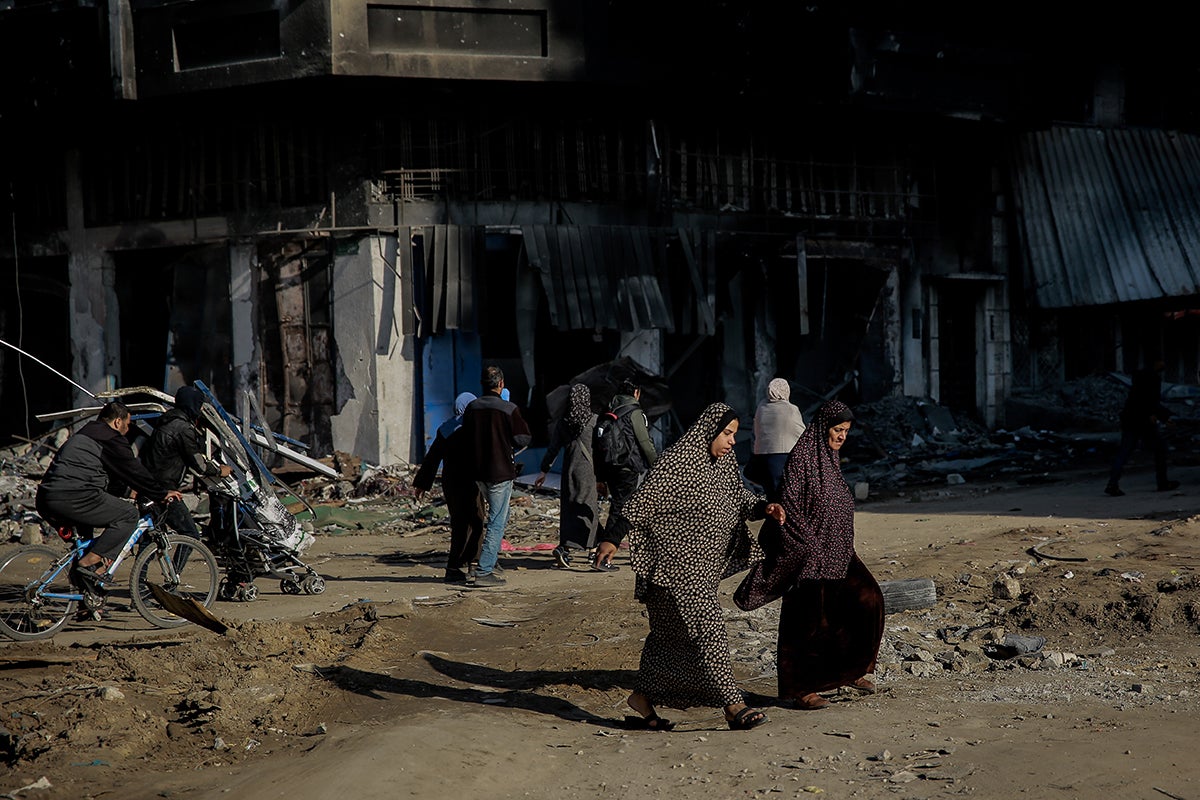
Two women cross the road and are surrounded by destroyed buildings at al-Jalaa Street in the center of Gaza City on 11 January 2024. Photo: 蘑菇视频ICEF/Omar Al-Qattaa
There is “no food, no water, no tents, there is no place to go to the bathroom,” said Khalil. She described a recent call with her aunt in Gaza, who said that running water was sometimes available for two hours a day—and at other times for only two hours per week.
“So when the water comes, she starts filling it in buckets, anything she can fill,” she said, adding that her family has been mixing what water they have into a plate of rice to make a thin soup.
“They have that for three days,” Khalil said. “There are no eggs, no chickens, no goats…nothing, even the animals are not alive anymore.”
“And I feel so bad that I can eat and they can’t.”
“Because there is no water… They cannot wash their hair. So, there is a lot of lice now. They are shaving their hair.”
As of February, water production in Gaza had dropped to just 5.7 per cent of pre-7 October levels, according to the IPC report. Beyond immediate needs for hydration, the lack of water has also forced women to make stark choices to preserve their hygiene.
“Because there is no water, they cannot take a shower. They cannot wash their hair. So, there is a lot of lice now. They are shaving their hair,” Khalil said.
Khalil also shared the story of some of her family members in Gaza who were expelled from their home.
“The Israeli soldiers called them to leave their building. And after a week, his daughter had to give birth and there was no water,” she said. “I don’t know how she gave birth without water. That was inhumane.”
“What women in Gaza need right now is ceasefire.”
On 1 March,??that more than 4 out of 5 women (84 per cent) said their family was eating half or less of the food they had prior to 7 October, with mothers and adult women being those tasked with sourcing food, yet eating less than everyone else. Nearly 9 in 10 women reported finding it harder to access food than men.
When thinking about the long-term impacts of this crisis, Khalil said, “when I look [at] the girls and women in my family and try to give them support, I don’t know how they will look at the world [after this]. And how will they recover?”
“I’m sure they will rise again,” she added, “what women in Gaza need right now is ceasefire.”
Document Sources: 蘑菇视频 Women
Subject: Armed conflict, Food, Gaza Strip, Human rights and international humanitarian law, Hunger, Internally displaced persons, Shelter, Water, Women
Publication Date: 21/03/2024
URL source: