Secretary General’s Message to Ä¢¹½ÊÓƵ Country Teams
Secretary-General calls on Ä¢¹½ÊÓƵ Country Teams to put Indigenous Peoples at the centre
Following the adoption of the 2030 Agenda, the Ä¢¹½ÊÓƵ Secretary-General Ban Ki-moon has at several occasions been calling on Ä¢¹½ÊÓƵ Country Teams to putÌýindigenous peoples as a top priority in the implementation of the Agenda.
“If the United Nations doesn’t care, then who will care? … It is our moral responsibility” Secretary-General Ban Ki-moon to Ä¢¹½ÊÓƵCTs
Below are the highlights from the Secretary-General’s recent statements –Ìýas inspirationÌýto Ä¢¹½ÊÓƵ Country Teams on howÌýto support Member States in ensuring the rights of indigenous peoples.
Why focus on indigenous peoples?
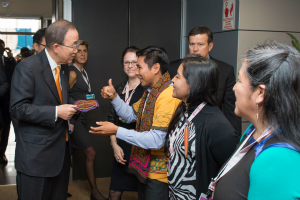 All over the world, indigenous peoples face exclusion, discrimination and multiple challenges not only socio-economically, but also in terms of threats to their cultures, languages and identity. Indigenous peoples should therefore be part of the United Nations’ core work. “If the United Nations doesn’t care, then who will care?â€�, the Secretary-General asked, emphasising that it is the United Nations’ moral responsibility to act.
The global framework for leaving no one behind
The Sustainable Development Goals (SDGs) provide an improved framework to work on indigenous peoples’ issues compared to the Millennium Development Goals, where indigenous peoples were almost invisible. The 2030 Agenda also reflects a strong commitment by world leaders to confront inequality, marginalization and to leave no one behind. Ä¢¹½ÊÓƵ has an important role to play in making this a reality for indigenous peoples. and
“I really count on your strong commitment in this” Secretary-General Ban Ki-moon
The recognition of indigenous peoples
The recognition of indigenous peoples varies from country to country, and region to region. There are some governments who do not recognise the existence of indigenous peoples. However, a comprehensive international framework is in place, providing for the recognition of indigenous peoples’ rights. This includes: the United Nations Declaration on the Rights of Indigenous Peoples adopted by the General Assembly in 2007; the Special Rapporteur on the Rights of Indigenous Peoples, the Expert Mechanism on the Rights of Indigenous Peoples, and the Permanent Forum on Indigenous Issues. “We have the system, but how to make this system move and implemented, that is more important�, underscored the Secretary-General. .
The tools available to Ä¢¹½ÊÓƵ Country Teams
The basis for Ä¢¹½ÊÓƵ Country Teams’ support to Member States on indigenous issues is the United Nations Declaration on the Rights of Indigenous Peoples (2007), which establishes a universal framework of minimum standards for the survival, dignity, well-being and rights of the world’s indigenous peoples. To support the implementation of the Declaration, the Ä¢¹½ÊÓƵ Development Group in 2008 adopted specific guidelines to assist the Ä¢¹½ÊÓƵ system to mainstream indigenous peoples’ issues into the operational activities and programmes at the country level. In addition to the Declaration, the ILO Convention No. 169 on Indigenous and Tribal Peoples and the Outcome Document from the 2014 World Conference on Indigenous Peoples provide further guidance.
- Tools for Ä¢¹½ÊÓƵ Country Teams (Links)
The Ä¢¹½ÊÓƵ system working as one
 The Secretary-General also emphasised how important it is to mobilise the entire Ä¢¹½ÊÓƵ system to work together. In regards to indigenous peoples’ issues, a system-wide action plan has been developed with the specific objective of enhancing coherence and coordination within the Ä¢¹½ÊÓƵ system. “What I am really asking you, is that we should break the normal attitude of working in silos and avoid duplications… You must think as one, act as one and deliver as one. This is the best way to fully utilise our limited resources,â€� said the Secretary-General, also encouraging the World Bank and IMF to be part of that process together with Ä¢¹½ÊÓƵ Country Teams. .
The Ä¢¹½ÊÓƵ system working all year round
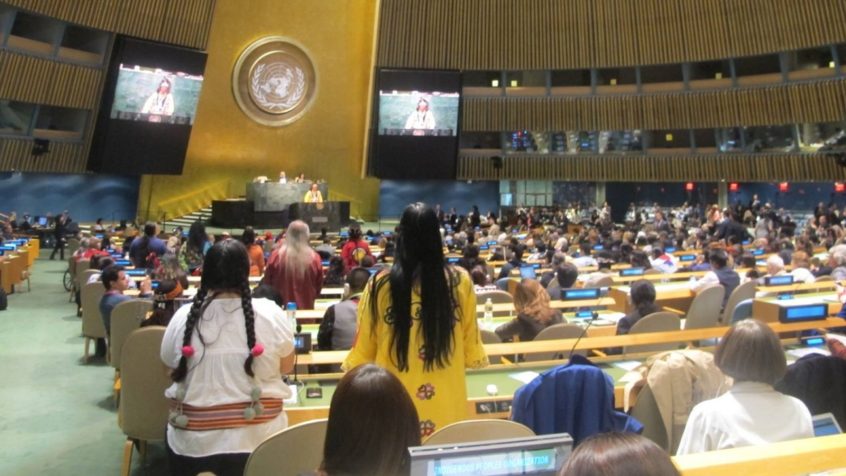
The Secretary-General emphasised the role of the Permanent Forum on Indigenous Issues and its annual session which brings together indigenous peoples, Member States and Ä¢¹½ÊÓƵ agencies, programmes and funds. While always attending and acknowledging the importance of the annual sessions, the Secretary-General calls on the Ä¢¹½ÊÓƵ family to work on indigenous peoples’ issues as a matter of priority throughout the year and at all levels.
Reaching out to the Ä¢¹½ÊÓƵ Secretariat
The Secretariat of the Permanent Forum on Indigenous Issues, Division of Social Policy and Development, Ä¢¹½ÊÓƵ Department of Economic and Social Affairs provides support to the Ä¢¹½ÊÓƵ system, including Ä¢¹½ÊÓƵ Country Teams, with information, technical and policy advice, facilitation of capacity building and/or national policy dialogues to ensure that the Ä¢¹½ÊÓƵ Declaration for the Rights of Indigenous Peoples is implemented. Read some of the recent accounts from the Ä¢¹½ÊÓƵ Secretariat’s visits and support to Ä¢¹½ÊÓƵ Country Teams from and . Or for more information.